
Materials and specifications
Ceramic products and materials
We select innovative materials that are ideal for your applications
Our products are suitable for myriad uses: from our technical ceramics, which are perfect for industrial ovens and heating systems, to our dielectric ceramics, intended for heating elements, rheostats and power resistors, all the way to our electrical insulators and custom ceramics designed to the client’s specification. For each product, we select the most suitable material – i.e. the ceramic paste that can deliver the highest level of performance for the envisaged use.
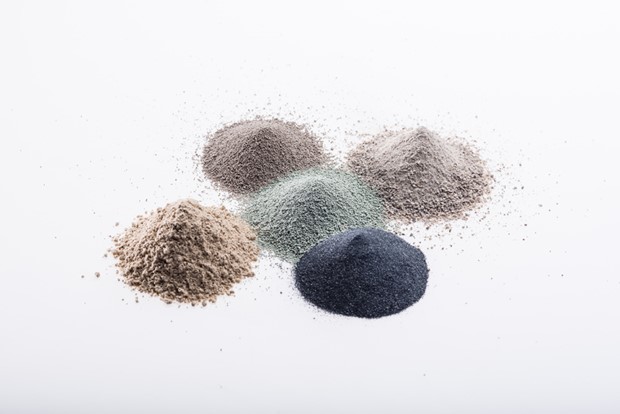
Industrial ceramic pastes for every application
All ceramic materials have certain characteristics in common, such as their refractory nature (i.e. their capacity to resist very high temperatures), their hardness, chemical inertia and very low levels of thermal and electrical conductivity. Moreover, the various ceramic pastes are all eco-friendly and offer great value for money. They differ in terms of their raw materials and the processing procedures.
Here is a list of some of the materials that we produce:
- Porcelain
Composed of a mixture of quartz, kaolin and feldspar, this ceramic material offers exceptional electrical insulation, even at high voltages; in addition, it has high levels of mechanical resistance and hardness and excellent chemical resistance.
- Thermodielectric
This finely porous ceramic material is the result of Savar’s research, and is composed of magnesium aluminium silicate. Offering good electrical insulation, it can be used at high temperatures (up to around 1250 °C) and also delivers a high level of resistance to thermal shock. Thanks to these properties, thermodielectric ceramics are extremely versatile, and are used in electrical applications, in heat insulation and in the refractory sector.
- Cordierite
Cordierite is a ceramic material composed of magnesium aluminium silicate. It is highly resistant to thermal shock. For applications that involve sharp drops in temperature, we use C520 porous cordierite, which features low conductivity and a low efficient of thermal expansion.
In the electrotechnical field, C410 dense cordierite is used due to its excellent dielectric rigidity.
- Mullite-alumina
This ceramic compound of aluminium silicate offers excellent stability at high temperatures. Thanks to its exceptional properties of resistance to thermal shock, it is widely used in the construction of industrial ovens. By modifying the content of alumina (between 60% and 90%), the compound can also be used for applications in the thermal and petrochemical sectors.
- Steatite
A compound based on magnesium aluminium silicate, steatite features low porosity and good electrical insulation. It is used in many industries, particularly in electrotechnical applications. It is suitable for the die-casting of small-scale components, such as bushings and interlocking beads.